Further Assessment
Filling the gaps in the puzzle

Why might further assessment be needed?
Often, the reasons for a young person’s learning, behavioural, or emotional difficulties are invisible – it can feel like we don't have a full understanding of their underlying needs. In other words, we have missing pieces in our jigsaw puzzle!
Educational psychologists can offer a range of different assessments to help disentangle these needs. Examples are a Psychoeducational Assessment (if a learning difference like dyslexia is suspected) or a Functional Behaviour Assessment (to understand the reasons why a behaviour is happening).
If a psychologist has completed specialist training in neuropsychological development/assessment, they can also look at neurodiversities such as Autism Spectrum Disorder or ADHD. At Wonder Psychology & Learning, we can have the training and competency to cover these areas as well.
What kinds of needs do we assess?
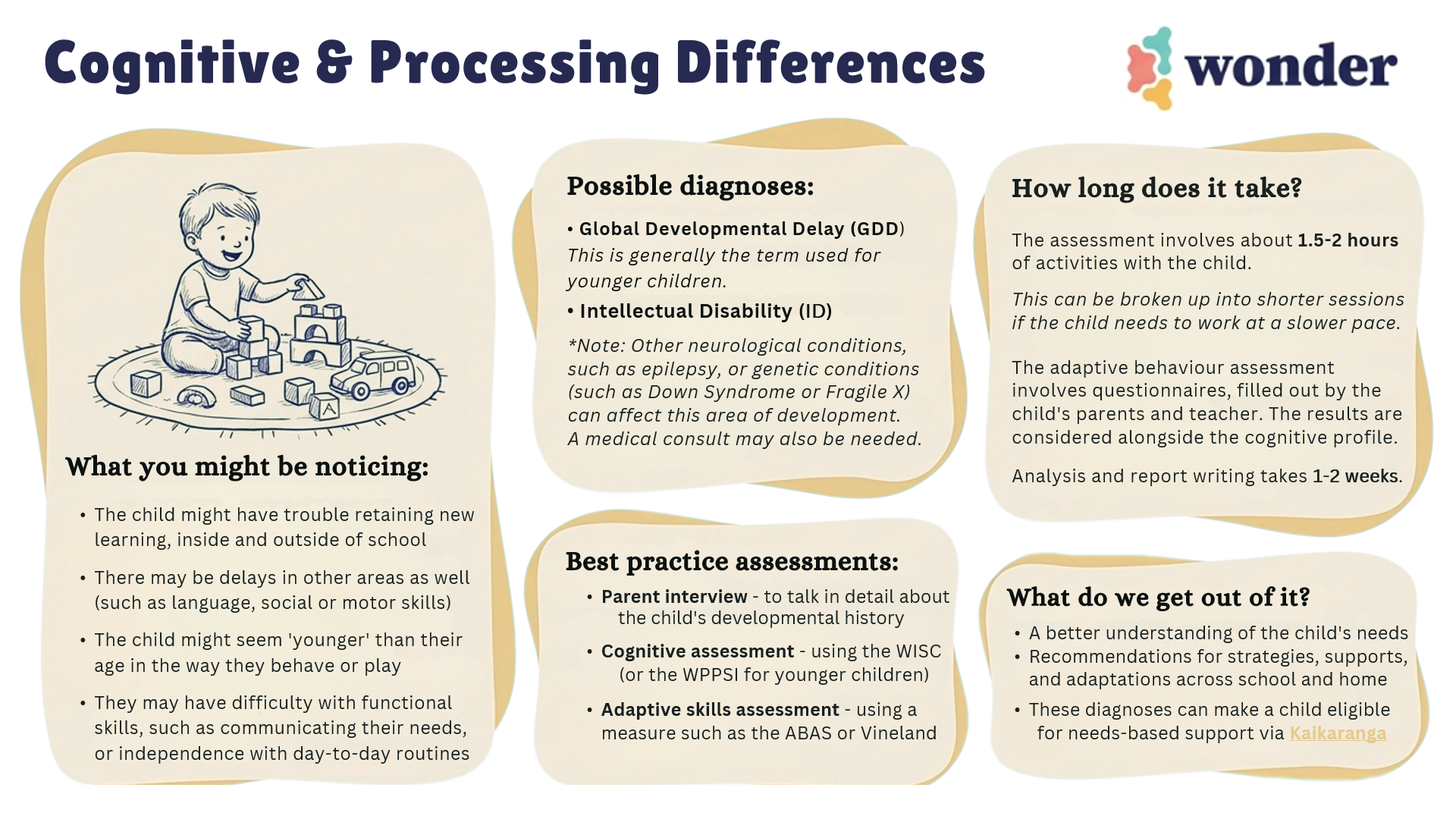
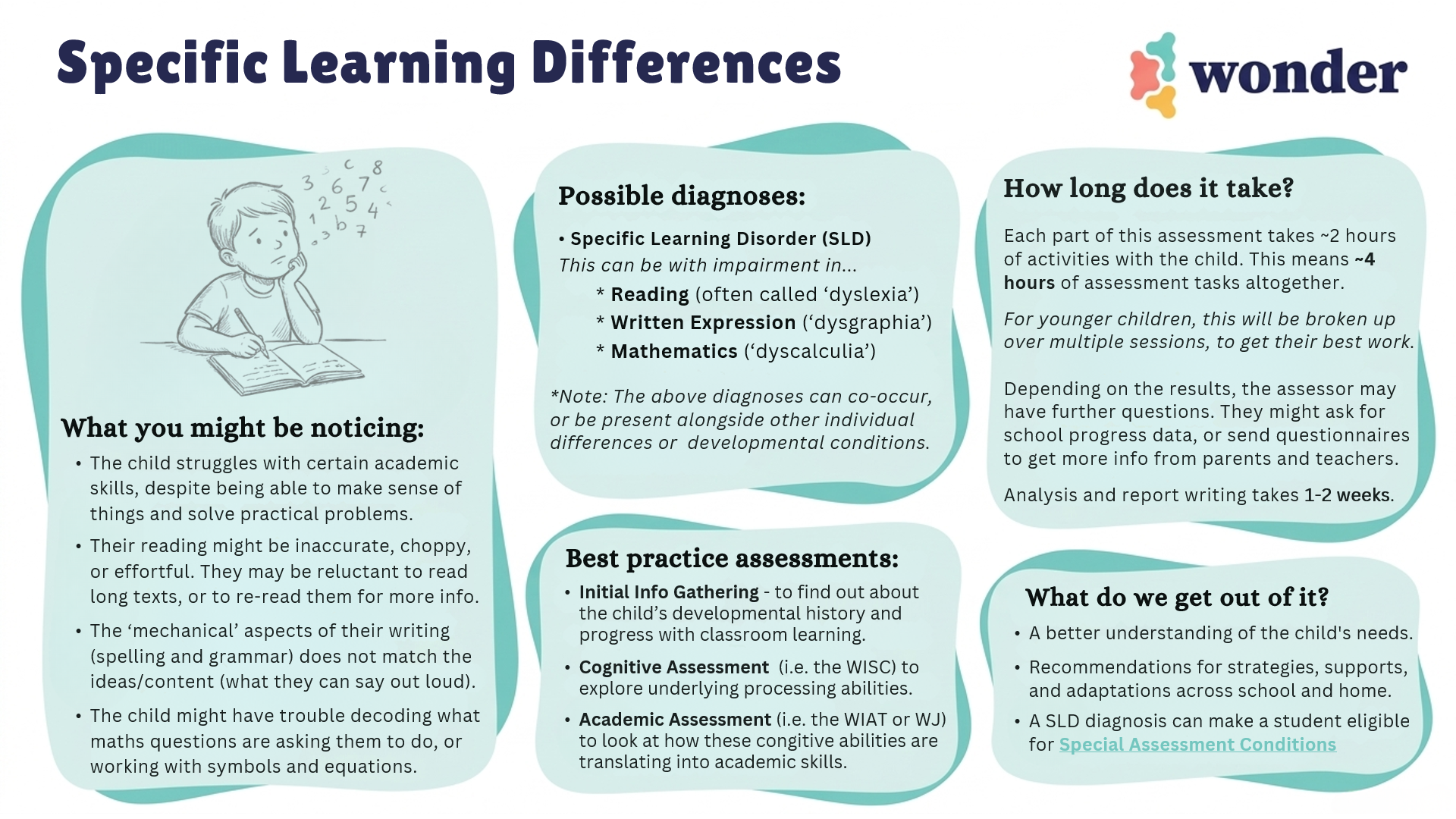
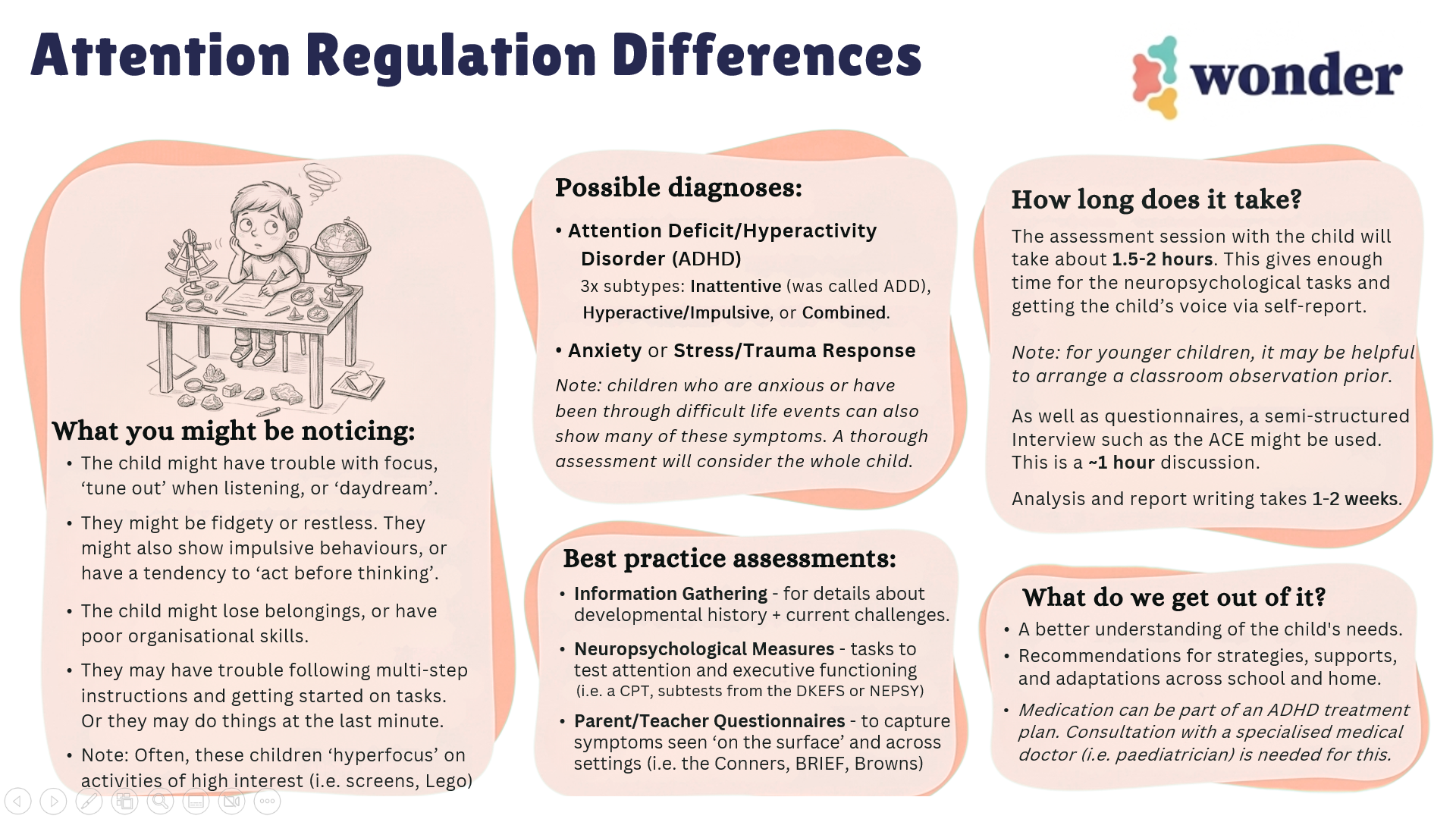
We work across three key domains of need…

Sometimes, a young person’s needs are in the area of overlap between two of these domains. Often, needs will interact across all three domains. At Wonder, we look at the whole picture!
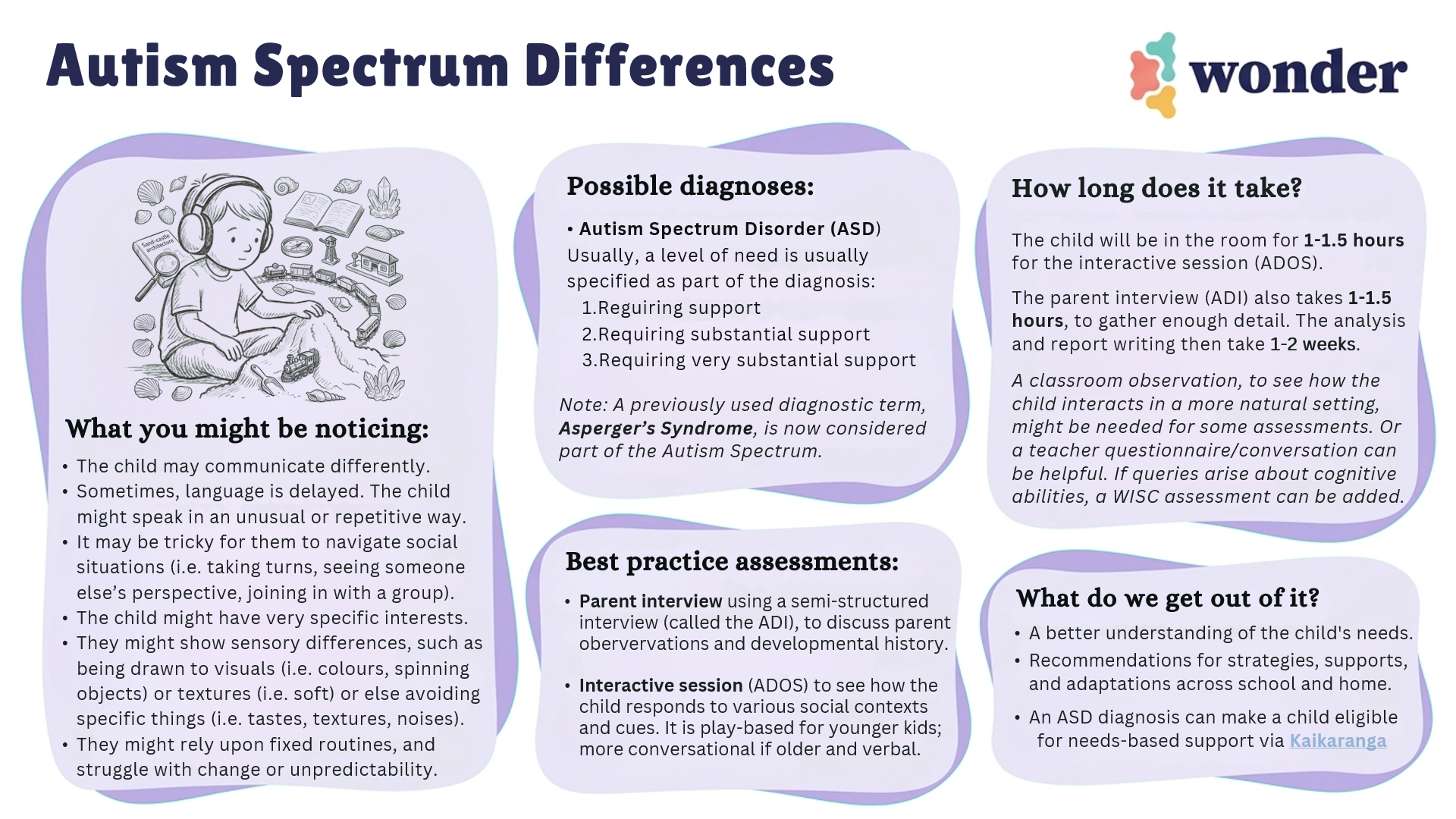
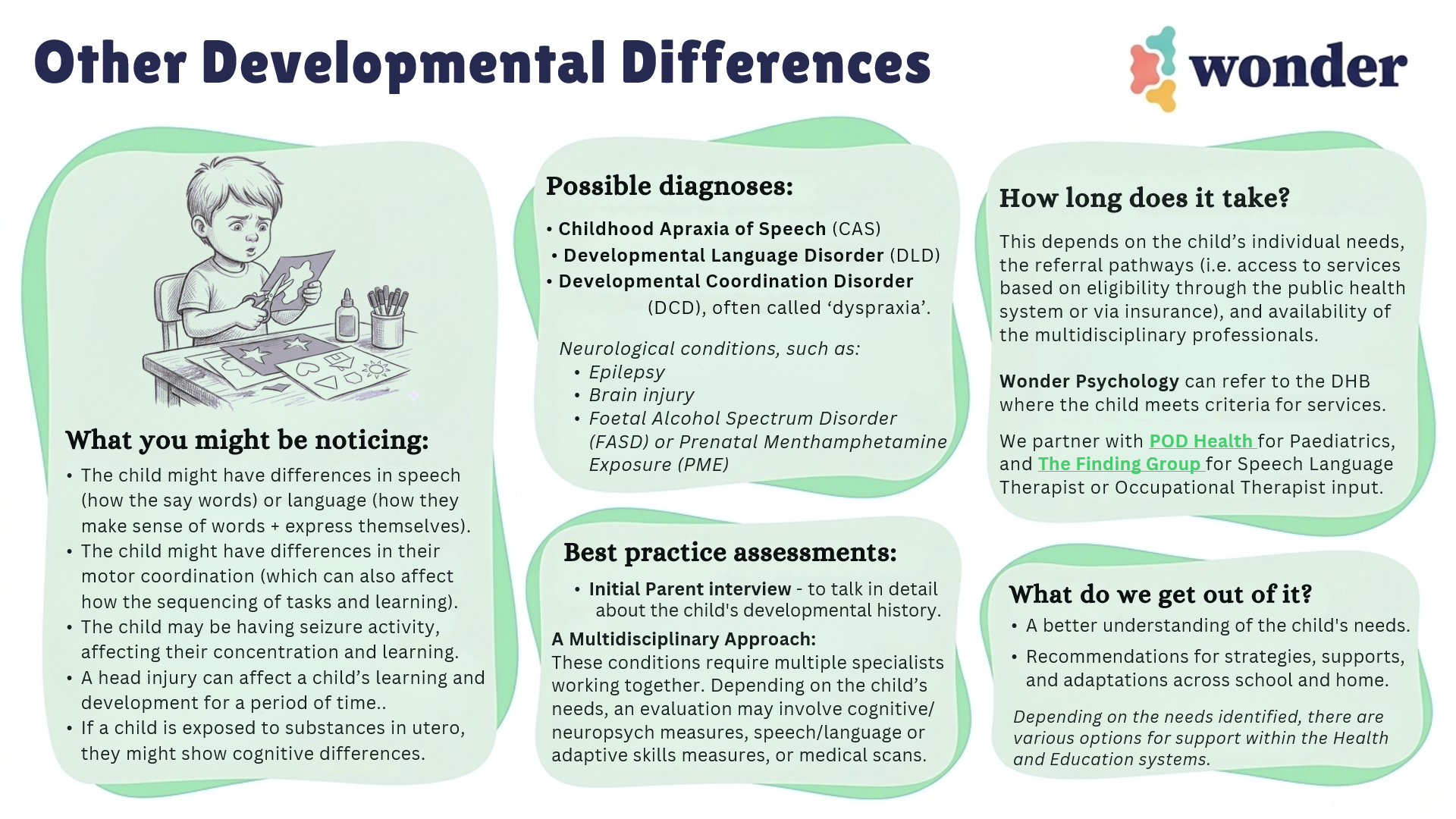
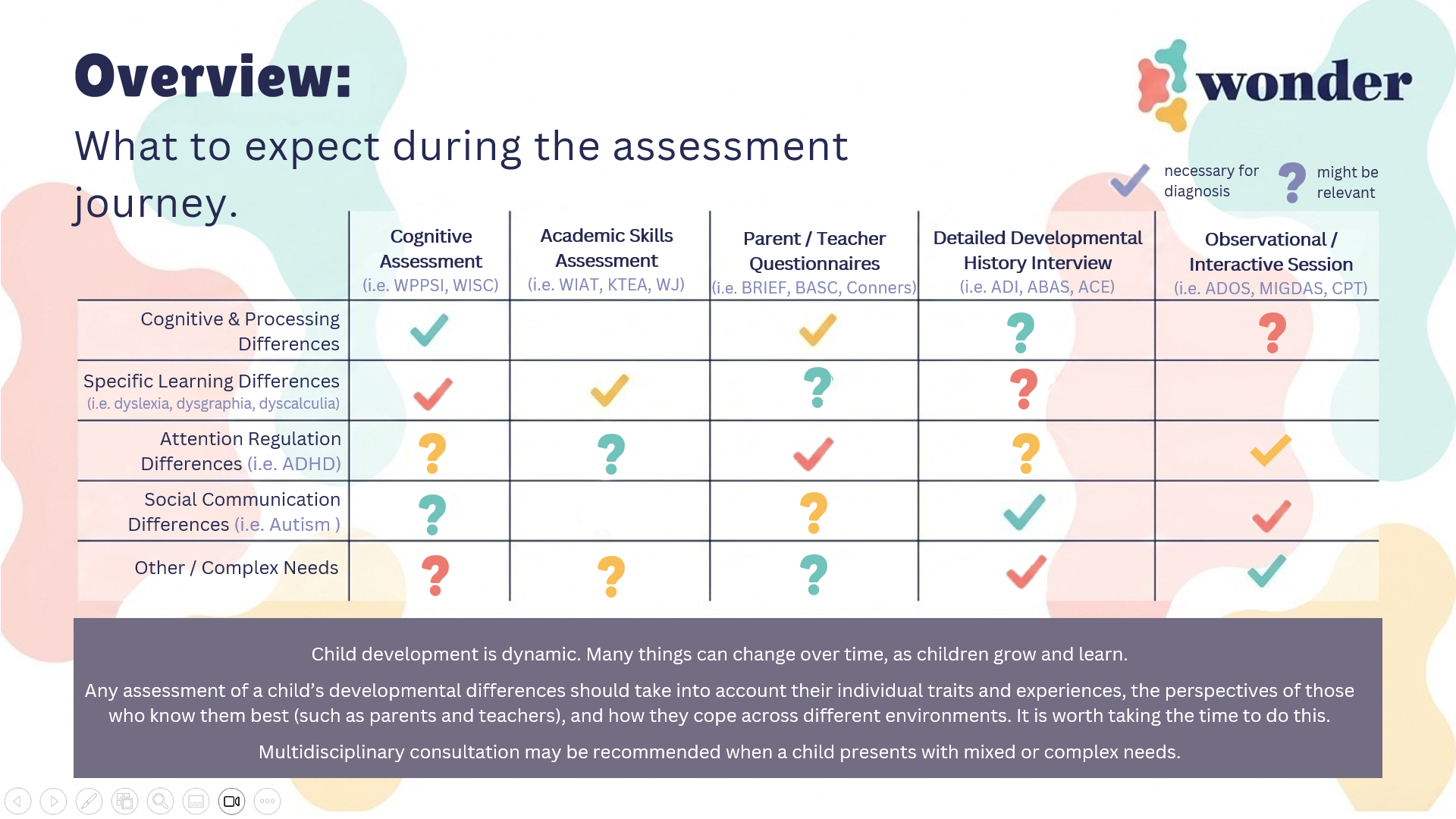
Our psychologists combine different assessment approaches to suit the young person and their situation. You can check out some of the options, and possible diagnoses, below...
What’s involved in an assessment?
Our approach to assessment will depend on the young person and their presenting needs. This can vary based on the referral information, or else the findings of our teamwork during in the
Navigational Phase.
This is our point of difference at Wonder. We provide individually tailored assessments.
Here's how it tends to work...
① Information Gathering
If we do not already have the information from our "Navigational Phase", the psychologist will want to get up-to-speed with the child's presenting needs and context. This may involve:
o Request for paperwork (developmental history form + any prior reports)
o Contact with the school (if consent is given, it's helpful to hear teachers' observations about the child's engagement + progress with their learning)
o An initial meeting (to chat, just as the 'grown ups' first, or else a chance for a young person to meet the psychologist and 'try before they buy'!)
Timeline:
1-2 weeks for this exploratory work.
② Diagnostic Assessment Measures
Next, we move onto the more 'formal' assessment measures (but don't worry - we still make these fun for the child!)
Assessments tasks could include:
o Cognitive subtests with the young person - these are different kinds of activities to explore their ways of processing (puzzles and word games).
o Academic subtests with the young person - tasks to check how these cognitive abilities are translating into their reading, writing, and maths.
o Interactive session with the young person - to hear their voice, and to see how they respond to different kinds of prompts.
o Interviews with important people in their world (i.e. parents, teachers)
o Further observations might be conducted across different settings.
o Behaviour tracking - we might ask parents or teachers to collect some data for us, to help us see the behaviour patterns across home and school.
o Questionnaires to gather more detailed information.
The child will be booked in for 1-2 sessions with the psychologist.
Note: there is usually a waitlist for these.
③ Analysis & Interpretation
Once the assessment data has been collected, the psychologist will take some time to analyse all of the information and make sense of it all.
Dependent on the scope of assessment.
④ Feedback (choice of pathway)
We have two different pathways for debriefing assessment results:
o Written Summary + Meeting
o Comprehensive Report
We know that different people’s brains work differently! These options mean that we can tailor the format of our feedback to what you and your child will find most helpful.
Depending on the age of the child, we like to involve them in the process and give them a chance to understand their own strengths and differences. We do this in a strengths-based and developmentally appropriate way, in consultation with the parents.
You are welcome to bring other team members, such members of the whānau who also spend time with your child, and the child's teacher or the school's Learning Support Coordinator (LSC) into the process. That way, we can ensure everyone is on the same page and contribute towards the action plan for supporting the child across home and school.
It is up to you who gets invited to the meeting, or who the report is shared with. We will discuss with you what your preferences are.
Normally 1-2 weeks after assessment sessions.
⑤ Follow Up (as required)
After assessment feedback, we can provide follow up through:
o Referrals onwards (to other services, as necessary)
o SAC declarations (for eligible secondary school students)
o Our
Flexible Support options.
Completed based on individual needs.
The cost of a full assessment depends upon the scope:
$800 - $1,100
+ navigational phase
$1,650 - $1,950
(GST inc.)
What do we get out of the assessment?
These assessments are a deep dive, to help us disentangle those 'invisible' needs.
Through either feedback pathway, you will get an explanation of what it all means. This will be more verbal/conversational if you opt for the summary document (with a few pages of documentation to record the key results plus some brief interpretation). If you request a formal report, the explanation will more analytical in style (this takes more writing time, so the verbal feedback you receive will be shorter).
You will also get strategies for moving forwards: either a list of recommendations as part of a comprehensive report, or contribution to the home/school action plan via a meeting with the child's support crew. It usually works best if support plans are made with the school's existing templates and processes. The ownership of the plan then sits with the home/school team, but a psychologist is always able to consult into the plan and suggest tweaks to strategies etc.
What if we want both kinds of feedback?
Absolutely okay! Some families want both a comprehensive written report and the strategy generation/planning meeting. Or, sometimes people make one choice and change their minds!
The additional time will be charged at the
hourly rate of $210 (GST inclusive).